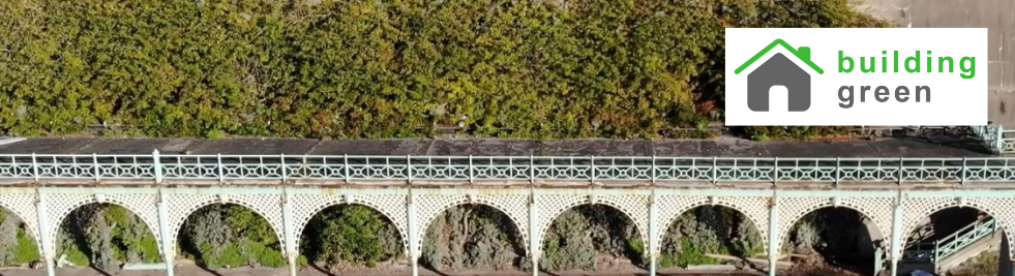

Today, 18 November, is a momentous day in the history of east Brighton. For finally, after a decade of closure, work begins to restore a section of Madeira Terrace.
According the Council news release, “Work to restore the first 28 arches and build a new, fully accessible lift is expected to be completed in summer 2026. An important part of the renovation of Madeira Terrace is improving biodiversity and revitalising the Green Wall, which has grown along the East Cliff wall for more than 150 years, predating the Terrace itself. During 2022 /23, expert surveys of the plants forming the Green Wall were conducted to help us understand more about their health and how best to ensure that there is a thriving Green Wall is again after the renovation. Those surveys revealed that all the plants have rooted into the wall at various points, which has allowed them to grow so tall. These plants now get most of their nutrients and water from the wall through their aerial roots, rather than from the ground through their main stems. As a result of this it is unfortunately not possible to retain the majority of the existing spindle plants, given the works that are needed to the wall.”
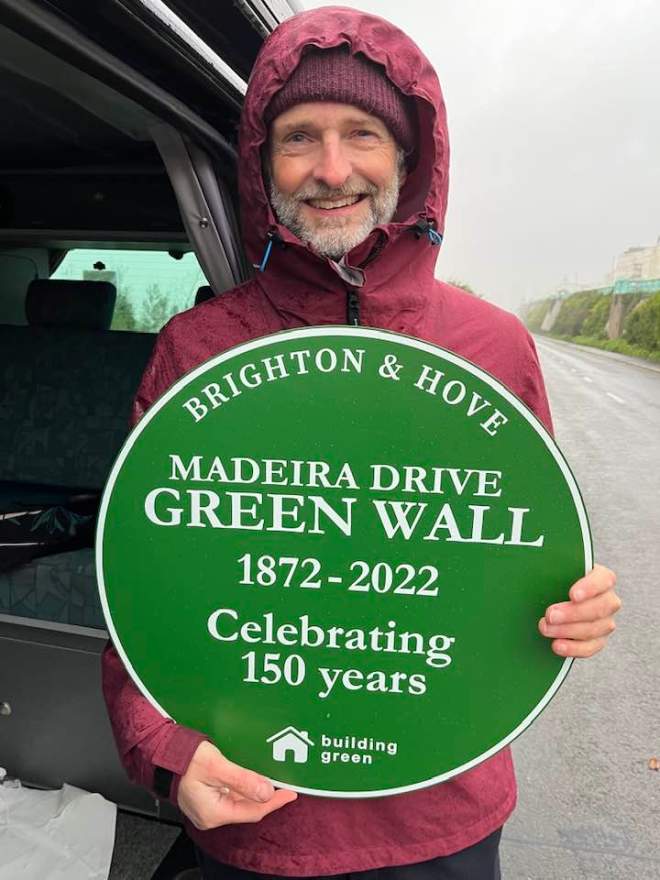
For us at Building Green, it’s always a sad day to see biodiversity loss, especially at a site where the planting is over 150 years old.
Our campaign to safeguard the longest, oldest green wall in Europe began in 2006. We are proud to have secured the designation of the wall as a Local Wildlife Site in the City Plan, and seen it lauded in international conferences, and on the TV.
Building Green, with partners, But we recognise the need to ensure the supporting wall is safe and sound, and we note the Council’s commitment to fully restore and enhance the green wall.
“The detailed plans have been carefully developed with conservation specialists and with input from the Advisory Panel. They will lead to the Green Wall becoming more biodiverse and greener when the work is completed. It will cover far more of the cliff wall than it currently does. However, it will take time to achieve this and the first step towards a restored Terrace is to remove the majority of the existing vegetation. This is necessary so that essential engineering works can be carried out to the face of the A259 retaining wall, which also supports the Terrace. The new climbers and planting will need to establish and have time to grow up the wall. The planting works are the last stage of the project, and I’m looking forward to seeing the results when we are once more be able to enjoy this iconic piece of our heritage in 2026“.
- Councillor Jacob Taylor, Deputy Leader and Cabinet member for Finance and City Regeneration
The Council continue: “One of the first operations the contractor will do is to remove the vegetation. It is only after this that the challenging task of dismantling the structure can get underway. This will be followed by breaking out of the concrete deck. It is the deterioration of the deck that was one of the main reasons the Terrace was closed to the public.
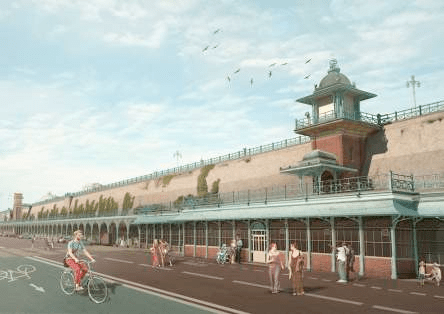
To enable the deck to be dismantled safely the Royal Crescent Steps will be temporarily closed for about one week in early December. Notices of the closure will be put up at the top and bottom of the steps to provide advanced notice of the exact dates. Alternative access points at Duke’s Mound and the Colonnades will remain open throughout the works.
The parking bays between the Royal Crescent Steps and Concorde 2/Madeira Shelter Hall will also be removed and won’t re-open until the Terrace opens in summer 2026, but we will announce alternative provision next month. The bays to the east and west of this area will remain available.”
You can read more about the Green Wall revitalisation on the Council’s Madeira Terrace restoration web page, and watch our film here.
 Brighton & Hove Building Green